Lion's Mane Mushroom Benefits: What the Science Actually Says
Lion's Mane is the most talked-about cognitive supplement of the decade. But the wellness industry is full of inflated claims. Here's what the peer-reviewed research actually says — and what it doesn't.
What is Lion's Mane Mushroom?
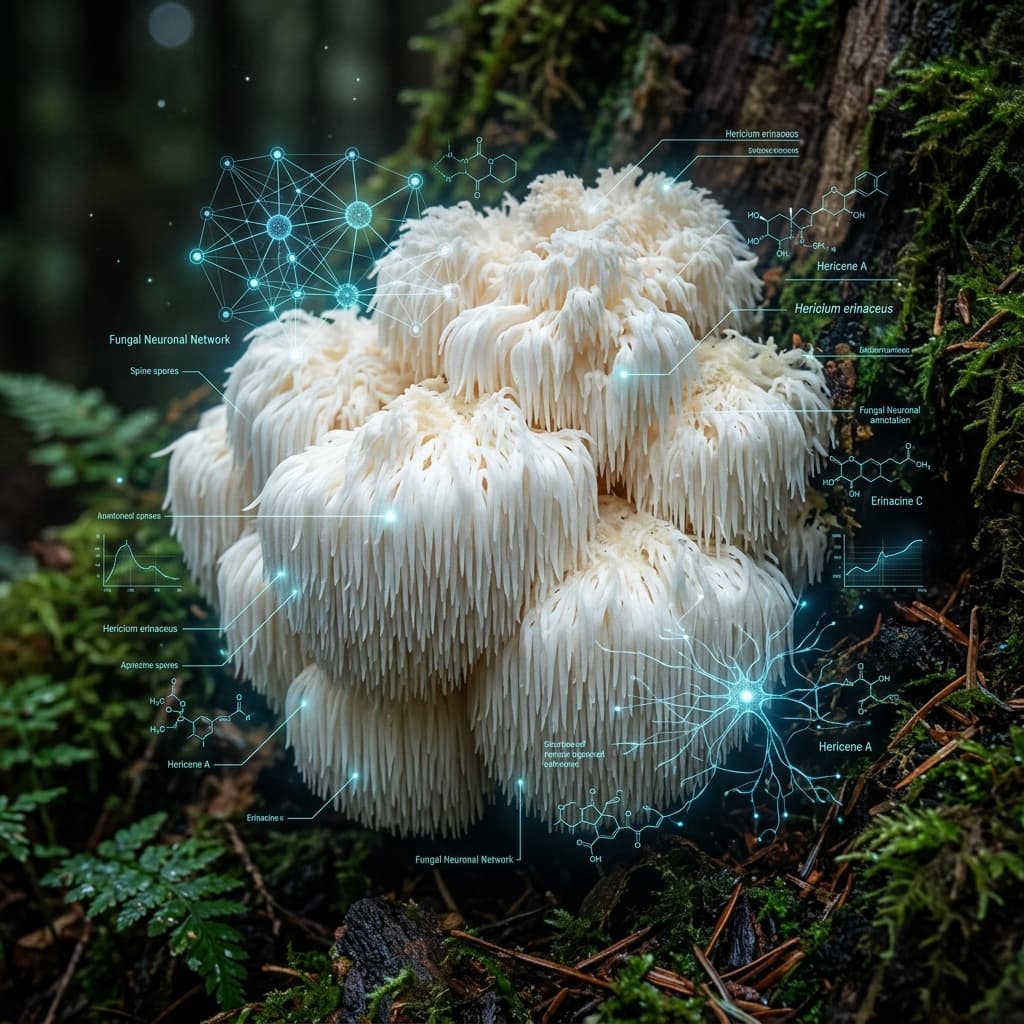
Lion's Mane (Hericium erinaceus) is a large, white, shaggy mushroom that grows on hardwood trees in temperate forests across Asia, Europe, and North America. Its distinctive cascading spines resemble a lion's mane — hence the name. While edible as a culinary mushroom with a mild, slightly sweet flavor resembling seafood, it's most valued today as a functional supplement for its unique bioactive compounds: hericenones (from the fruiting body) and erinacines (from the mycelium).
The NGF Mechanism: How Lion's Mane Affects the Brain
The core mechanism behind Lion's Mane's cognitive effects is its ability to stimulate the synthesis of Nerve Growth Factor (NGF) — a protein that supports the growth, maintenance, and survival of neurons, particularly in the hippocampus (the brain's memory center) and the prefrontal cortex (the seat of executive function, decision-making, and working memory).
NGF was discovered in the 1950s by Nobel Prize-winner Rita Levi-Montalcini and is essential for neuronal health throughout life. Without adequate NGF, neurons deteriorate — this is associated with cognitive aging and neurodegenerative conditions. Lion's Mane is the only known natural food compound that directly stimulates NGF synthesis in the brain.
Hericenones vs. Erinacines: The Key Compounds
Two classes of compounds in Lion's Mane have been identified as NGF stimulators:
Hericenones (Hericenones C through H) — found exclusively in the fruiting body (mushroom cap). These are lipid-soluble aromatic compounds that have been shown in research to stimulate NGF synthesis in vitro at concentrations achievable through oral supplementation. Because they're found only in the fruiting body, supplements using mycelium-on-grain have minimal hericenone content.
Erinacines — found in the mycelium. These are diterpene compounds with excellent blood-brain barrier permeability, meaning they can cross from the bloodstream into the brain directly. Multiple erinacine isoforms (A through K) have been identified with varying degrees of NGF stimulation activity.
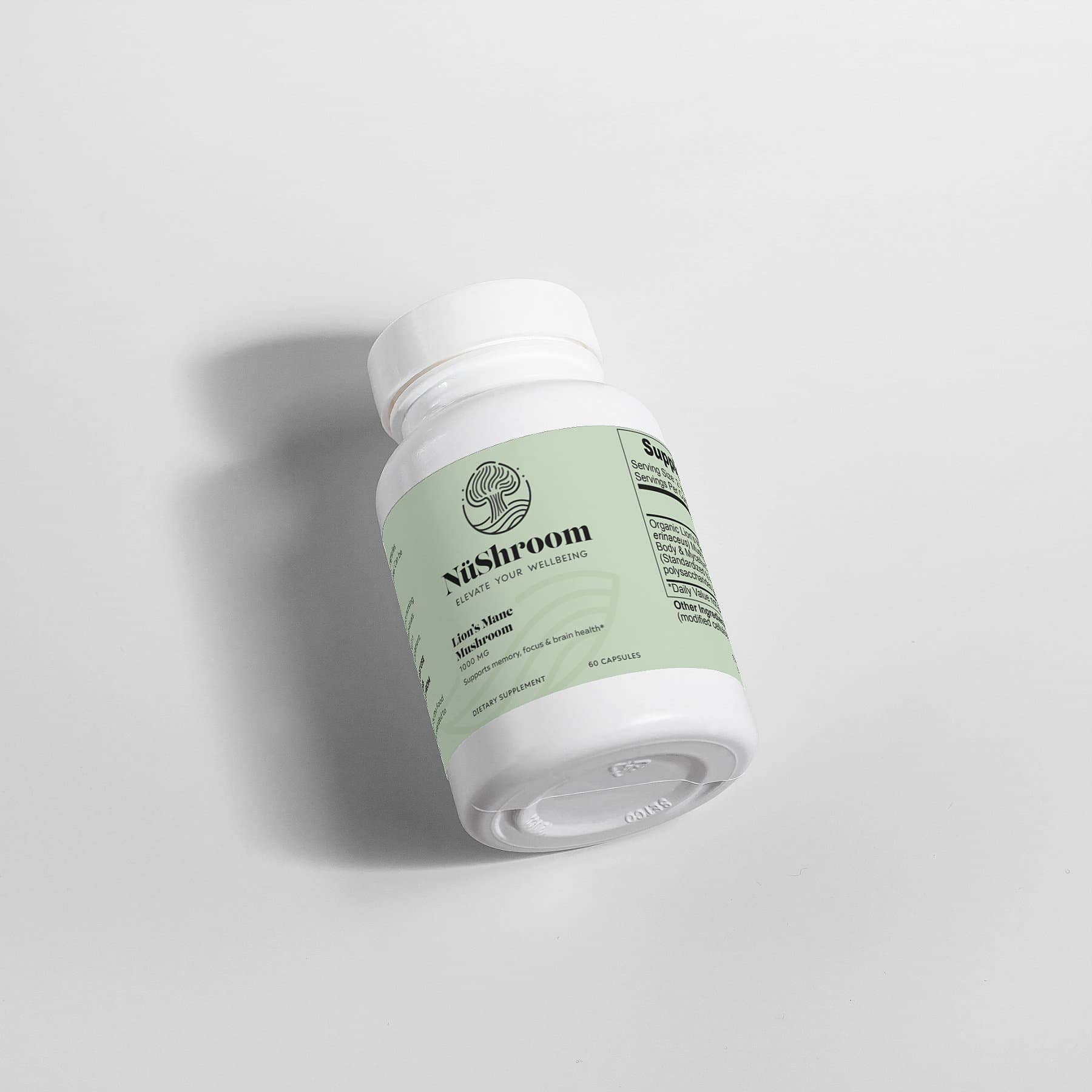
Practically: the best Lion's Mane supplements use 100% fruiting body for maximum hericenone content, as these are the most accessible and consistent compounds for manufacturers to standardize. NüShroom's Cognitive Clarity Capsules are standardized to 40% polysaccharides from 100% fruiting body.
What Does the Clinical Research Show?
The clinical evidence for Lion's Mane is among the strongest in the functional mushroom category, though it's important to distinguish between in vitro (cell culture), animal, and human studies.
Key Human Clinical Studies
The Mori et al. 2009 RCT (Phytotherapy Research): 30 Japanese men and women aged 50–80 with mild cognitive impairment were randomized to 1,000mg of Lion's Mane extract daily or placebo for 16 weeks. The treatment group showed significantly higher cognitive function scores on the Hasegawa Dementia Scale at weeks 8, 12, and 16. Critically, scores declined after supplementation stopped — providing evidence the effects were from the mushroom, not placebo.
The Nagano et al. 2010 study: 30 women were randomized to Lion's Mane cookies or placebo for 4 weeks. The treatment group showed significant reductions in anxiety and depression scores, and improvements in concentration.
The Saitsu et al. 2019 trial: Investigated Lion's Mane's effects on cognitive function and mood in healthy adults aged 50+ — found improvements in cognitive function scores compared to placebo after 12 weeks.
What Lion's Mane Can and Cannot Do
Supported by evidence: - Stimulates NGF synthesis in vitro and in animal models at supplemental concentrations - Improves cognitive function scores in adults with mild cognitive impairment (multiple RCTs) - Reduces anxiety and depression scores in some human studies - Supports neuroplasticity through NGF-driven mechanisms (animal and cell studies) - May have neuroprotective effects against amyloid plaques (animal studies — human evidence limited)
Not supported by current evidence (as of 2026): - Treatment or prevention of Alzheimer's disease (human evidence insufficient) - Acute performance effects within a single dose - Guaranteed improvement in healthy young adults (most strong studies used populations with baseline cognitive decline)
The honest summary: Lion's Mane has excellent evidence for stimulating NGF production and improving cognitive function scores in adults with some baseline cognitive impairment. Evidence in young healthy adults is more limited. However, given its excellent safety profile and the plausible mechanism, many healthy adults use it as a preventive/optimization supplement.
How to Take Lion's Mane for Best Results
Based on the clinical research:
Dose: Most positive human studies used 500mg–2,000mg of concentrated extract daily. NüShroom's Cognitive Clarity Capsules provide a clinical-relevant dose in the standard 2-capsule serving.
Duration: Effects build over weeks. The most significant benefits in clinical studies emerged at 8–16 weeks of continuous use. Don't judge based on 2 weeks.
Timing: No strong evidence for optimal timing. Morning or before deep work is the most common user preference for cognitive support.
Fruiting body matters: Given that hericenones (the primary NGF stimulators) are found only in the fruiting body, ensure your supplement uses 100% fruiting body or clearly specifies fruiting body + mycelium extraction.
Frequently Asked Questions
Does Lion's Mane actually work for focus?
Clinical evidence suggests yes — particularly for improving cognitive function and reducing brain fog. Multiple randomized controlled trials have shown meaningful improvements in cognitive function scores with 8–16 weeks of Lion's Mane supplementation. The mechanism (NGF stimulation) is well-documented. Results are most significant in individuals with some baseline cognitive impairment, but many healthy users report subjective improvements in focus and mental clarity.
How long does Lion's Mane take to work?
Some users report improved mental clarity within days. The most significant and reproducible benefits documented in clinical research emerged after 8–16 weeks of consistent daily use. If you're trying Lion's Mane for cognitive benefits, commit to at least 4 weeks before evaluating.
What is the best form of Lion's Mane supplement?
Fruiting body extract is the superior form for cognitive benefits, as hericenones (primary NGF stimulators) are found exclusively in the fruiting body. Look for products standardized to a specific polysaccharide percentage (20%+ is good; 40%+ is clinical-grade). Avoid 'mushroom powder' without fruiting body specification — it's likely mycelium on grain.